Is it in our nature to be competitive, selfish, lustful and violent, as we see in the countless BBC nature documentaries? And is it the function of our remarkable conscious brain to ‘manage’ these savage instincts? Or is this completely backwards and dangerously inaccurate? It’s a fascinating argument and one which there is much debate.
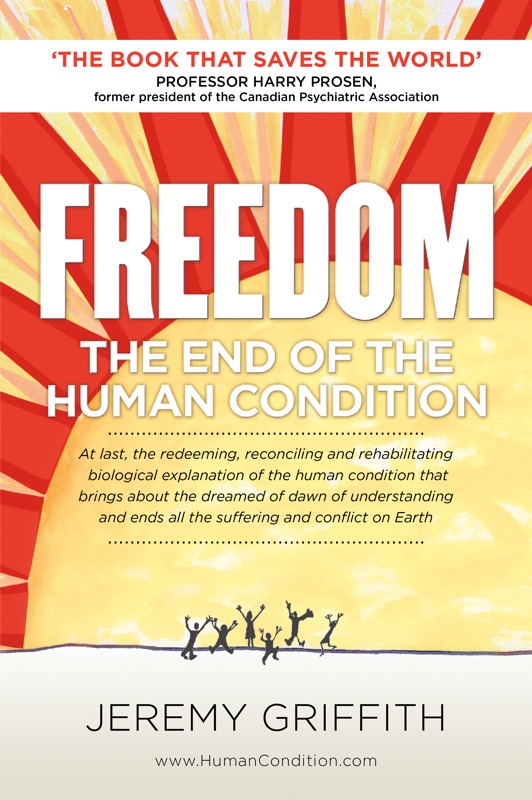
In 'FREEDOM: The End Of The Human Condition', biologist Jeremy Griffith draws on mythology, the scriptures, anthropological evidence and our closest living relatives, the Bonobo Chimpanzees, to present the reader with a remarkable picture of what our species’ instinctive behaviour actually is. He explains that pre-consciousness, our species experienced an “innocent, unconditionally selfless, genuinely altruistic, fully cooperative, universally loving, peaceful state”. He explains that our “moral instincts, the ‘voice’ of which is our conscience” arose from a process of ‘love-indoctrination’ that occurred in our primate forebears during this idyllic period in our species development.
He explains, through the use of a simple analogy, what the consequences were for our species when we developed our fully conscious brain — inevitably, a battle broke out between our already established instincts, and our developing intellect.
It is this division, and the sense of unease caused by not being able to explain this division, that has resulted in our conflicted, ‘good and evil’ condition — the ‘human condition’. He suggests we have lived with a subconscious sense of guilt about our worth as a species. And it is this subconscious insecurity about our worth that has been a driving force in so much of our behaviour and an issue we inevitably have had to avoid facing.
This key tenet to Griffith’s discourse is but a fraction of the scope that this book covers — I haven’t even mentioned the explanation for the meaning of life!! But my brief review cannot come close to doing justice to the scope and importance of this book.
Quite simply, the importance of this book cannot be overstated. Beyond the discussion of whether our behaviour is caused by the same forces we see at play in the animal kingdom, FREEDOM contains many questions we don’t stop to consider, and deals with subjects we subconsciously choose to avoid. This is clean, honest thinking that is both refreshing and confronting. But surely honesty is what we need for there to be any real human progress.
So be braced – this is not another feel-good, politically correct, new-age self-help book, and there is no 10-step guide to mindfulness or ego-repression. This book brings about ‘the end of the human condition’, as the title suggests, through first-principle based understanding. After presenting the biological explanation, Griffith then describes the situation facing the world, and delivers the honest assessment of our collective madness. Digesting this, you could conclude that the key to species’ emancipation is in honesty and acknowledging the extent of our alienation, which we now can, however Griffith explains that we just need to “get the truth up and move on”. As he says: “humanity now has the option to move on to an entirely new existence”.
Once you consider the simple explanation and it’s consequences, you see the human story is indeed remarkable. Griffith writes, “humans are wonderful beings after all. In fact, not just wonderful but the heroes of the whole story of life on Earth”. An absorption of this finds your whole outlook on life and yourself completely changed, with a renewed level of empathy for your fellow man and importantly, for yourself.
The potential for this book is enormous. Here’s hoping this mad neurotic world has the time to read it. It might just save us yet..